
Blog
Heat Treatment of Steel and Iron Castings: A Complete Technical Guide to Processes, Parameters, and Quality Control
Meta Description: A comprehensive engineering guide to heat treatment of metal castings. Learn annealing, normalizing, quenching and tempering, solution annealing, stress relieving, and austempering — with temperature ranges, holding times, cooling rates, and microstructure evolution for carbon steel, stainless steel, ductile iron, and more.
Heat treatment is the invisible differentiator in metal casting. Two castings poured from the same heat of metal, with identical chemical composition and identical as-cast geometry, can have completely different mechanical properties — one brittle and prone to cracking, the other tough and fatigue-resistant — based solely on what happens inside the heat treatment furnace.
For engineers specifying cast components, understanding heat treatment is not optional. The heat treatment specification on a drawing directly determines the part's strength, ductility, impact toughness, machinability, and dimensional stability. A poorly specified or incorrectly executed heat treatment is one of the most common root causes of casting failure in service — and one of the most preventable.
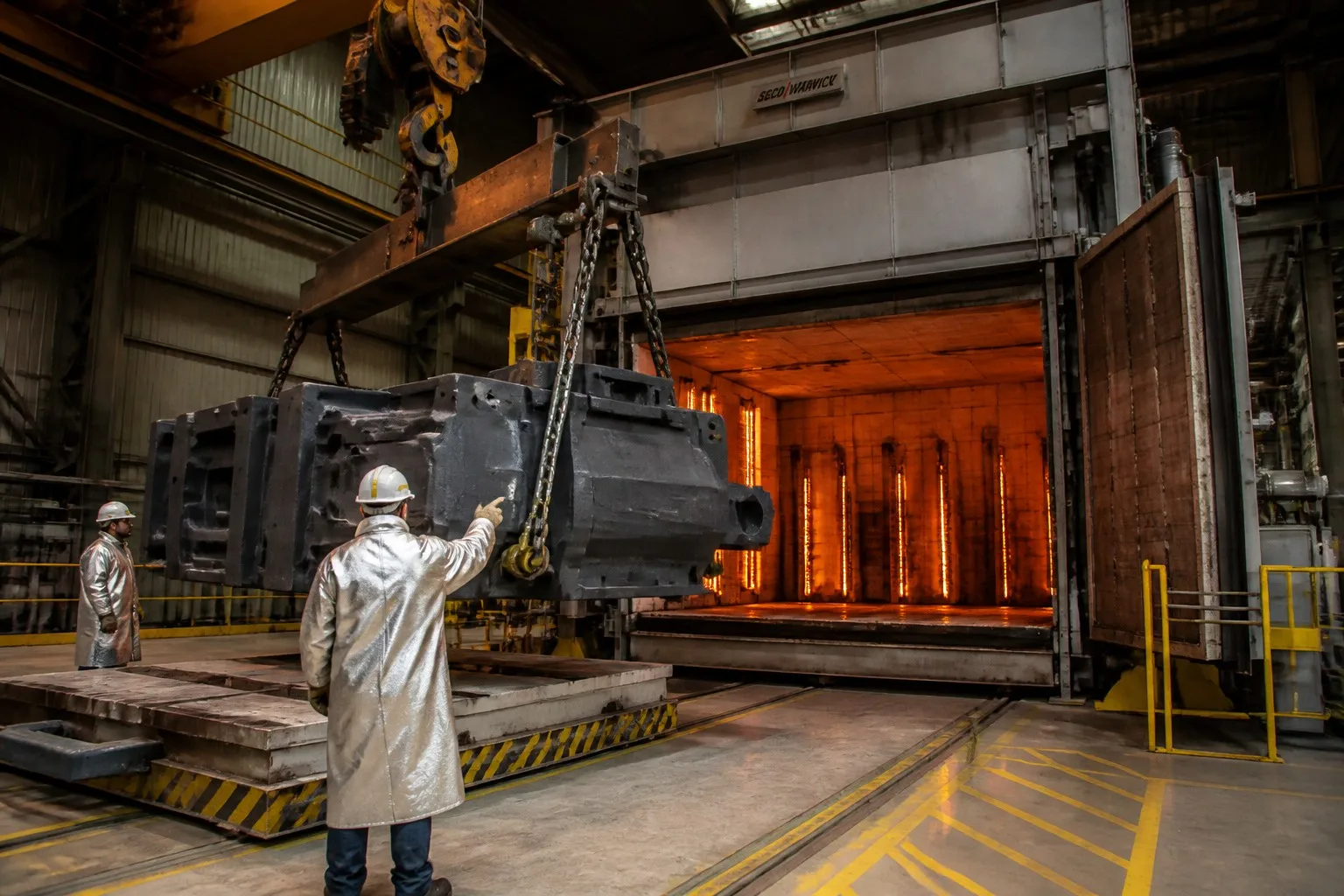
This guide covers the principal heat treatment processes applied to steel and iron castings, with practical parameters, metallurgical explanations, and quality control requirements.
Part 1: Why Castings Need Heat Treatment
Unlike wrought products (plate, bar, forging) that receive thermomechanical processing during forming, castings solidify in a static mold. The as-cast microstructure is determined entirely by the cooling rate from the pouring temperature — which varies dramatically between thick and thin sections of the same casting.
What Heat Treatment Accomplishes
A professional foundry with integrated heat treatment capability — such as Dandong City Pengxin Machinery Co., Ltd., which operates in-house normalizing, quenching, and tempering furnaces with calibrated temperature control and chart recording — ensures that every casting leaves the foundry in the specified heat treatment condition with full traceability.
Part 2: Heat Treatment Processes for Steel Castings
2.1 Stress-Relief Annealing (Stress Relieving)
Purpose: Reduce residual stresses from solidification and cooling without significantly altering the microstructure or mechanical properties.
How it works: The casting is heated to a temperature below the transformation range (typically 550–650 °C for carbon and low-alloy steels), held to allow thermal relaxation of elastic stresses, and slowly cooled. No phase transformation occurs — the process is purely thermal-mechanical.
When to specify stress relieving:
- Large castings with significant section thickness variation
- Castings that will undergo extensive machining (stress relief before machining prevents distortion during metal removal)
- Castings subject to dimensional stability requirements in service
- Castings that will be welded (stress relief after welding or weld repair)
Quality control: Verify furnace temperature uniformity (±15 °C across the working zone). The cooling rate is as important as the heating cycle — cooling too quickly reintroduces thermal stress, defeating the purpose.
2.2 Full Annealing
Purpose: Produce a soft, machinable microstructure with maximum ductility. Full annealing completely transforms the as-cast structure to coarse pearlite and ferrite (for hypoeutectoid steels).
How it works: The casting is heated above the upper critical temperature (Ac₃) — typically 850–950 °C for carbon steels — held to fully austenitize the structure, then cooled very slowly (furnace cooling) to produce equilibrium ferrite-pearlite.